Saturday, January 14, 2012

January 2012

Planters Punchlines
Men’s Garden Club of Wethersfield
January 2012
~~~~~~~~~~~~~~~

Next Meeting - Monday January 23rd

@ The Pitkin Community Center @ 7:00 p.m.

Harrison Griffin, a retired Agriculture Teacher and ninth generation dairy farmer, will talk about the Community Supported Agriculture project that he and his family have started in Suffield. In its third year, Oxen Hill Farm supplies its shareholders, and also merchandises direct to the public at several area farmer's markets including Wethersfield's. Their website is www.oxenhillfarm.com.

Compostable Matter
By Jim Meehan

Even though it started out badly, this is turning out to be a very good winter for the squirrels that reside at the Meehan homestead.

On the last weekend of October a snow-laden limb from our Magnolia tree flopped over and severed our connection to our street’s electrical power grid – the very same grid that had already ceased to operate that afternoon. At about the same time a large Oak branch containing one of the tree rat’s larger condominiums (aka “dray”) crashed to the ground. And the bough on our Flowering Crab tree that held our three principal bird/squirrel feeders broke off and crashed to the earth. Several trash bins full of other lumber also tumbled into our yard.

As part of the first wave of our cleanup, Marsha and I retrofitted the seed cafeterias to one of the remaining offshoots of the decorative fruit tree, and rested the broken end of the severed limb atop one of the other remaining branches in order to provide a bit of nearby shelter to our guest diners. Within hours the now homeless refugee rodents were drowning their sorrows in pouch fulls of sunflower seeds. And we were off to the town’s well-heated Community Center where, along with our Hartford based health club, we spent our waking hours during the weeklong blackout.

Ironically we had tree work scheduled for our yard on that Monday. Realizing that the planned work would have to take a backseat to emergency jobs they now had to do I called the tree company and, asked if they could please make a quick stop and prune back our Magnolia so as to eliminate the possibility of another power wire takedown.

I also told them to leave the flowering crab – which had been on the original order as a “check it over and assess” – alone. A week or so later, after we had our electricity back, an out-of-state subcontractor for our arborist dropped by while we were out and (a) cut back the wrong parts of the Magnolia and (b) carried away the fallen branch that Marsha and I had so carefully set in place.

The yard pets seemed unfazed by these arboricultural errors. Marsha and I however had come to like the new form of entertainment provided by the broken limb playscape. Birds gathered on the dead branch, chattering away as they waited their turn at the dining table.

Squirrels, sometimes performing as a group, ran in a continuous nose-to-tail cycle across and up and down the fallen branch – abruptly changing direction in perfect unison through a series of rapid-fire, gravity-defying maneuvers impossible to execute in three dimensions, and equally difficult to describe in 2-D words. When doing their solo acts the bushy-tailed rodents leapt fearlessly from their new playground perch onto our latest “squirrel proof” feeder – which up until that point had largely lived up to its name.

This alleged squirrel foiler is made up of a square-sided plastic tube with several feeding holes, surrounded by a separate metal cage with leaf shaped decorations. The cage is attached to springs. The tube is not. When a squirrel latches on to the outer enclosure, it drops down and its ornamental leaves cover the apertures on the immovable plastic feeder. Amazingly this Rube Goldberg contraption actually functions as advertised. The squirrels' weight does indeed force the metal shell down so that its doors shut tight against the plastic-lined feeding holes on the interior tube. The little rats still climbed up onto the feeder and gnawed away at the metal (unsuccessfully) and plastic (successfully) but quickly became frustrated and returned to the ground where they were humiliatingly forced to feed on the castoffs of their much lighter feathered dining companions.

But now, apparently fired up by the easy access provided by their new “shelter”, the squirrels hurled themselves at the beleaguered feeder with such frequency that at pretty much any time during the day one of the tree rodents was either on, or in mid-flight on its way up to the feeder.

And they stayed on it longer when they got there.

What the squirrels finally figured out, possibly under the influence of the playscape induced adrenaline, was that once they gnawed away enough polyethylene to make the food portals larger than their covers, the sunflower seeds simply tumbled into their greedy little mouths.

And we figured out that if we wanted this traveling circus to continue its performances, then we needed a new playscape. Fortunately one of the large branches from our copse of arborvitae cedars had also been damaged during the surprise snowstorm.

So with a little pruning-saw action, and some long distance dragging, the birds and squirrels had a newer, even better (because it had foliage) “shelter”. Marsha decorated it with shiny red, blue and gold ornaments for the holidays and I verbally stopped the arborists from removing it when they finally came to perform our originally contracted work and to properly prune the Magnolia.

Our house wires are safe from our timber. And, as the real cold weather settles in, our birds and squirrels continue to find new ways to enjoy their playscape – and entertain us. Not only is it going to be a good winter for our squirrels, but hopefully for us too.

Some Hard Truths About Gardening In Connecticut
A Tongue-In-Cheek Look At The Trials And Tribulations Of Gardening In Connecticut by Deborah Roberts @ stoningtonpatch.com

If you’ve been gardening in Connecticut long enough, you’ve probably learned a few hard truths along the way. You know, those lessons we seem to have to re-learn every season. Gardeners are optimists at heart, but sometimes it helps to acknowledge we really have very little control over what happens in our gardens. Here are a few truisms about Connecticut gardening that I’ve learned over the past few decades that may save you some headaches and a few heartaches.
Mother Nature has a strange sense of humor. And she likes to remind us of that fact at least a few times each year. Don’t take it personally.

If you’re not killing a few plants each year, you’re doing something wrong. Sometimes we’re to blame and sometimes Mother Nature hastens the decline. But either way, those deaths will teach you how to be a better gardener.

Grass really does grow better in your flowerbeds than it does in your lawn.

Never take a cut of mint from a well-meaning neighbor. And while you’re at it, beware of plants, especially groundcovers like mint, that are labeled ‘vigorous’. They are the bullies of your garden, quickly outcompeting nearby plants.

‘Free-seeding’ is gardening code for ‘you’ll be spending tons of time on your hands and knees next spring pulling out unwanted seedlings’.

When it comes to perennials, if the deer don’t eat them the rabbits probably will. And if the rabbits don’t like them, they are probably candy for groundhogs. Or voles.

Remember, deer don’t read the same books as we do. They don’t know which plants are supposed to be ‘deer resistant’ and which ones aren’t.

There’s always one more rock or one more root to remove in order to have the ’perfect’ planting hole.

However improbable it may seem, you do control the amount of rain the rest of the state receives. When the weatherman calls for 2” of rain and you decide NOT to water your garden, you’re prolonging the dry spell for the rest of us. But if you drag out the hoses and water your garden, the skies will open up and it will rain and rain and rain.

Imagine it’s mid-Autumn and you have a bunch of daffodils bulbs that still need to be planted. Don’t wait until next weekend to get them in the ground. Chances are it will snow and your window of opportunity will be slammed shut. On the other hand, if you do plant them now, then the ground probably won’t freeze until January so you really could have procrastinated a little bit longer.

Speaking of bulbs, what you’ve suspected all along is true…the squirrels and chipmunks are watching exactly where you plant those bulbs so they can dig them up a few hours later.

9 Garden Myths Demystified
Don't let these classic superstitions waste your time or harm your plants
John C. Fech @ finegardening.com

I learned that you shouldn’t believe every bit of gardening advice you hear in graduate school, thanks to my statistics professor, Walter Stroup, who loved to wear his “Walter Beer” hat during class. This weird-looking derby made from yarn and beer cans was a gift from one of his former students. During the first class, Stroup explained he always wore his Walter Beer hat when he fertilized his plants and wearing it was what caused them to grow so well. The purpose of his anecdote, I realized, was to impress upon his students the importance of questioning every claim and bit of advice.

We have all followed someone’s gardening advice without knowing if it was based on sound information. As you maintain your garden, consider if your techniques are simply ideas passed down through the ages or smart practices based on solid science. Here are a few of my favorite myths and the truths we should all embrace.

Myth: If a plant is under stress, it should be fed
Truth: Fertilizing plants that are not nutrient deficient can lead to additional stress. Fertilizer is added to plants growing in poor soils and to plants that show symptoms of lacking a particular nutrient. Generally, when a plant is stressed, it’s not from lack of food. Compacted soil, heat, salt spray, faulty planting, and improper placement are usually the culprits that stress plants. It is important to rule out other environmental conditions before deciding a plant is underfertilized. When fed, stressed plants use up energy that is better spent on growing roots, walling off decay organisms, or defending against insects.

Myth: Cover newly pruned areas with varnish, tar, or paint
Truth: There really isn’t a way to keep fungal organisms out of a new cut. In about half of the situations where these wound dressings are used, the tree’s heartwood decays faster than it would have without the topical application. The paint or tar holds moisture near the new wound, which, unfortunately, helps the various fungal decay organisms grow. Instead, simply make a clean cut just outside the branch collar and leave it alone. If pruned properly, trees can take advantage of natural defense mechanisms to ward off most decay problems.

Myth: Organic pesticides are less toxic than synthetic ones
Truth: Misused pesticides can be harmful, regardless of whether they are considered natural or synthetic. Pyrethrum, for example, is made from chrysanthemums but is still toxic to people and pets when handled improperly. Whenever possible, it’s best to select the least toxic control option available because, even if not lethal, many of these pesticides can cause serious health complications. Safe storage of these products can help prevent any harmful accidents. Read and follow all label directions, and remember that these products are tools, not miracle workers or silver bullets. Pesticides cannot correct mistakes made in plant selection, installation, or maintenance.

Myth: Newly planted trees need to be staked and guy-wired
Truth: Staking a tree can hinder its proper development. This practice was once a landscape industry standard, driven by a gardener’s inner desire to do something good for the plant to help it grow. It’s best to avoid staking unless the new tree is located in a windy or on a sloped site. Allowing the tree to sway in the wind encourages the development of stronger stabilizing roots. If staked, the tree may become dependent on this support, preventing the root system from becoming strong and healthy. If it is truly necessary, tie the trunk loosely to the stake using fabrics such as T-shirts or bicycle inner tubes to avoid damaging the bark, and remove the support after one growing season.

Myth: When it comes to fertilizers and pesticides, if a little is good, twice is better
Truth: A precise measurement of these materials is crucial to the health of your garden. If you like to watch the Food Network, you’ve probably seen Emeril Lagasse “kick it up a notch” by adding a little more of a certain spice. This approach may be fine for cooking but not for gardening. Fertilizers can raise salt levels in the soil to toxic levels, burning the roots and stunting growth of your plants. Pesticides, when overused, can also have similar detrimental effects on plants by burning the leaves or raising toxicity levels in the soil. Garden products, both organic and synthetic, are extensively tested during research and development to provide safe and reliable results, so using the exact recommended dosage is the best practice. I recently witnessed an impatient gardener spray some cucumber beetles with a very concentrated solution of an insecticide; the bugs died but so did some of the cucumber vines.

Myth: Sunshine focused through water droplets will burn leaves
Truth: The diffused rays of the sun are not powerful enough to cause burning. If it were the case that water droplets burned leaves, farmers would encounter huge losses after each daytime rainstorm. In fact, lawn care professionals often cool turf by spritzing water over the foliage during the hottest part of the day. In general, the best time to water most garden plants is early in the morning because of higher municipal water pressure, a lower evaporation rate, and the potential to reduce foliar diseases that often occur in overly moist situations. But if you are left with no other choice, watering midday will not harm your plants.

Myth: Add sand to loosen heavy, clay soil
Truth: The worst remedy for a clay soil is to add sand. This practice turns the clay soil into a rock-hard, mortarlike substance. Instead, use organic matter, like compost, to loosen heavy soils because it is light in composition and also improves nutrient quality. Sand can improve a clay soil, but it must be added until it constitutes most of the mineral composition of the soil. At that point, it’s not really clay soil any longer; it is sandy soil.

Myth: When planting a tree or shrub, dig the hole twice as wide and twice as deep as the root-ball
Truth: A planting hole should be twice as wide as the root-ball but no deeper. By applying this planting principle, you will encourage the roots of a plant to grow out, which creates stability and allows the plant to readily find water and nutrients. A good way to make sure that the root-ball is at the right depth is to place the top roots so that they are parallel with the soil surface and then apply 2 inches of mulch over them. Think of it as a “planting area,” instead of a “planting hole.” Don’t add compost or potting soil when backfilling the planting area. Most roots prefer to grow in these amended soils instead of spreading out through the landscape.

Myth: Drought-tolerant plants don’t need to be watered
Truth: All plants need to be watered to become established. Most “drought-tolerant” plants such as Russian sages (Perovskia spp. and cvs., USDA Hardiness Zones 6–9) and black-eyed Susans (Rudbeckia spp. and cvs., Zones 3–11) are those that can survive through an average summer without supplemental watering. These plants, however, are usually not drought tolerant in the first year, and regular watering and an application of mulch are good ideas. After that, you can pretty much allow them to fend for themselves, but even the toughest of plants will benefit from a monthly soaking.

Debunking Garden Myths: Garden Myths Not Worth Repeating
laptopgardener.com

Myths, old wives tales, and folklores abound even in the world of gardening. Gardening lore often gets passed from neighbour to neighbour as homegrown tips based on little or no scientific research. The myths start out as common sense conclusions and keep getting perpetuated time after time. Pretty soon they are part of the global gardening consciousness and they are believed to be true. Once this happens it is almost impossible to undo the belief. The poinsettia poison myth is still being trounced after eighty years. Well, here’s my attempt to dispel some popular garden myths.

Myth: Botanical “natural” pesticides are toxic to pests and harmless to other living things (including gardeners). Not true, in fact some botanical pesticides that are derived from poisonous plants are even more toxic than commercially prepared ones. Both pyrethrum (made from Chrysanthemum cinerariaefolium) and rotenone (made from two tropical legume family plants, the South American Lacepod or Lonchocarpus and the Asia’s jewel vine or flame tree which is known botanically as Derris) are popular botanical pesticides. Pyrethrum and rotenone are moderately toxic to humans (particularly children) when inhaled or ingested. Interestingly both are extremely toxic to aquatic life, and are used as fish poisons.

The flowers of the chrysanthemum used to make pyrethrum are harvested shortly after they open and are either dried and pulverized or the oils from the flower are extracted using solvents. The active ingredient works on the nervous system to cause paralysis and death (if in sufficient quantities). Cats are particularly susceptible to poisoning from pyrethrums.
Rotenone is a contact and stomach poison that is made by grinding up roots and varies in its human toxicity from very high to low depending on how much of the pure derris root is used in the pesticide. Treat natural pesticides with the same caution that synthetic ones deserve (or give them even more). One of the most toxic pesticides is nicotine, which is derived from the tobacco plant.

Myth: The soil under oaks, cedars and pines is acidic. The top inch or so might be acidic, but if the bedrock underneath is limestone then the soil above that rock will be on the alkaline side. Oak leaves, cedar leaflets and pine needles have to build up for centuries to make a significant amount that will have any impact on alkaline soil.

Myth: Moss grows in lawns that need lime. Lots of conditions favour the growth of moss in lawns. Having an acid soil is not the most significant one of them. The most important reason that moss is found in the lawn is that conditions are not favourable for a lush, healthy lawn. Moss is an opportunity seeking plant and will settle almost anyplace that there’s an open spot. Too much shade, poor drainage (moist conditions), poor fertility or compacted soils are all conditions where lawns do not grow well. When this happens moss is almost certain to arrive. Don’t add lime to correct a moss problem unless a soil analysis indicates an excessively acidic result.

Myth: Mushrooms and toadstools sprouting in the lawn mean that the soil is deficient. On the contrary, fungi such as mushrooms and toadstools are living off nourishing decaying material. A rotting tree root or other decaying organic matter is likely the cause of the fungi. This is a good sign that there’s nourishment being added to the soil. The visible structures are the flowering and fruiting portion of an extensive underground plant.

Myth: Ants are needed to make peony flowers open. Many people believe that ants are actually eating the waxy coating from the peony so that the flower can open. Others believe that the peony is secreting a sugary substance that attracts ants to feed. In any case, the ant is enjoying a symbiotic relationship with the peony and is not doing any harm by being on the flower bud. Once the bloom starts to open the ants vanish. Peony flowers can open just fine without any ants – just ask a florist.

Myth: Some plants can repel mosquitoes. Amazing but not true, there are no plants that repel mosquitoes. If you rub the leaves of certain plants onto your skin, the oils and aromas can help discourage mosquitoes from biting. It is asking a lot of a plant to release essential oils into the air in quantities that can keep mosquitoes away for distances like 6 feet though.

Myth: Clay pots are better for houseplants than plastic pots. Clay pots cause the moisture in the soil to evaporate faster than plastic pots. This can be helpful for houseplants if the waterer is heavy handed – then clay is better. If houseplants are watered only when they need water instead of on a regular schedule then plastic pots should be adequate.

Myth: It doesn’t pay to use leftover seeds from flowers and vegetables. Most open packets of seed start to loose their viability as soon as they are exposed to heat and extreme humidity levels. If seeds are stored under ideal conditions in a tightly sealed jar in a dark, cool, dry location then they should store well for several years. The length of time varies according to the seed. To extend the viability even further, place some powdered milk in the bottom of the glass jar to soak up humidity.

Myth: Hostas are shade plants and don’t tolerate the sun. There are many hostas that perform very well in the sun if they are given adequate moisture. In fact, the native habitat for many hostas is in a sunny location at the edge of the woods. Some hostas that tolerate more sun are: Francee, Patriot, Sum and Substance, Gold Standard and Royal Standard.

Taking a moment to look at these myths with a bit of scepticism will hopefully lead gardeners, after some critical thinking, to come to the conclusion that not all gardening lore is valid.


Myths and Truths from the Garden
Renè Lindsey aka “The Plant Lady” @ northsacnews.com

Does this really work? Or is this going to hurt? That’s a question we often ask ourselves. Ever heard of an old wives tale? Why do we have to be old and have a tale to know what really works? I’m old now, 40 thank you, and I do think I finally might know what I’m talking about. My dear sista, Tiffy Boo, asked if I could cover myths & truths so maybe this is my best attempt.

1. Does watering my lawn in the hot sun burn it or burn my plant leaves? NO is the truth. Watering in extreme heat does not burn the lawn. Heat magnification burns occur from a distance like a bug & a magnifying glass. However, when hot the evaporation rate is accelerated and our water can vaporize and be a waste of money and resources.

2. To avoid transplant shock use B-1. This one took me by surprise, B-1 does nothing. It’s the other minerals and ingredients such as hormones. The B-1 is simply a marketing strategy. Wow!

3. Gypsum to break up clay soil: not exactly! At Home Depot we used to carry a product called Soil Buster. It contained 70% pelletized gypsum. There was even an article in the Sac Bee. Wow, sales boomed. Then the product was pulled. Hmmm. Yes the plot thickens.
Gypsum claims to soften hard clay soils. Gypsum is actually – (calcium sulfate) – and when added to high sodium soils (hard soil) it actually replaces the sodium (salts) with calcium leaving a more pliable desired soil. The sodium has now left the building, “as did Elvis”. TCB Baby!

4. The soil under pines and oaks is acidic. Yes and No. The first few inches are, however, if the bedrock underneath consists of limestone, then that soil will be on the alkaline side. It takes many years of leaf build up to counteract for the acidity to become an effect! FOOD FOR THOUGHT! LISTEN TO YOUR PLANT LADY.

5. Poinsettas are poisonous: NOT! Long, long ago a king’s son got sick after eating a bloom. Coincidence. Years of testing has proved.

6. Seeds are no good after one season! Wrong. Store in an air tight jar with a lid, with a little powdered milk in it to absorb moisture and keep them in the dark. They will last 5 years or more. I shoulda done this long ago.

7. Rubber mulch vs. bark – straw. Yes, as far as aesthetics goes rubber wins, does not decompose, fungi and insects do not desire it as a habitat, does not fade, etc, etc. However, if you place it in an area or live in an area high in fire significance it will be the easiest to ignite and the hardest to extinguish.

8. This one is just kinda cool. Country soil vs. urban city soils. Kinda like in the 70’s, free, flowing, soft, fertile out in the middle of nowhere, anything’s possible. Loose, no restrictions, oh the possibilities. That’s the country soils. Urban/city landscape is such a challenge relating back to the compaction of rock, soil & dead debris from the big heavy trucks when the neighborhoods were being formed. This could explain why our yards never look like grandma’s out in the sticks did. When housing areas are being formed all the soils are graded and scraped, flattened. Heavy equipment compacts the entire area, etc, etc, etc. Wow. Interesting. Therefore we gotta to bring in so much top soil, raised beds, etc. I woulda never thunk it.

9. Cover fresh cuts or pruned branches with tar, seal or paint: to keep fungus out, etc. This can actually be false! If the tree is pruned properly it can seal and heal itself if the cut is a straight clean cut right outside the branch collar. If done incorrectly and sealed off, moisture is held under the wound, bacteria incurs and fungal decay begins.

10. Last but not least: if we do everything right, then, by golly, nothing can ever go wrong! Sure. We all know this truth. Drive thru the country, take a trip to the Redwoods, Yosemite, Highway 101 Scenic Coast, Yellowstone, the desert, even Tahoe. Who designed and gardened that? The Garden God himself, the only green thumb there really is. Natural environments will always be our example in the quest to duplicate it for our own satisfaction. All that nature receives is poop and water and look at it. We’ll never be able to out do it. However, with a little grace and some effort we can achieve our own personal little piece of heaven in our own backyards. Sometimes less is more and new ain’t always better. I have learned the stupidest questions get the smartest answers. Trust me I have asked many in my time.

Horticulture Corner:

"Winter is icumen in,
Lhude sing Goddamm,
Raineth drop and staineth slop,
And how the wind doth ramm !
Sing : Goddam.”

Ezra Pound, Ancient Music

Wednesday, November 9, 2011

November 2011

Planters Punchlines
Men’s Garden Club of Wethersfield
November/December 2011
~~~~~~~~~~~~~~~

HOLIDAY PARTY TIME! (In lieu of Nov/Dec Meetings)


The annual club Holiday Party will be held on
Monday December 5,
5:30 – 9:00 p.m.
@ the Solomon Welles House, in Wethersfield.

Catered Food, Drink, Fellowship, and
Entertainment by the Wethersfield High School Choraleers.

Spouses/guests are cordially invited.
$15.00 per person ($30.00. per couple).

RSVP to President Tony Sanders at 860.529.3257
by Sunday November 20.

WESTON ROSE GARDEN “WINTER OVER”
Saturday November 26 @ 8:00 a.m.

Roses will be pruned back and the garden will be raked, weeded and covered with compost in preparation for the upcoming cold weather. All hands are welcome. BYO tools.

Compostable Matter
By Jim Meehan

Good evening everyone. And welcome to the first meeting of the B.B.B.F.F.B.F. – the Burning Bush Best Friend Forever Benevolent Fellowship.

I apologize for the cold, dark accommodations but being as we are an advocacy group for an officially declared invasive plant and therefore of necessity an underground organization we will be holding all of our gatherings in this abandoned root cellar at an undisclosed location on the once active Wilkus Farm property.

It is especially fitting that we meet now as this is the time of year when Euonymus alatus compactus is in its glory – displaying its spectacular red fall foliage for all to see, putting to shame those other pretenders at autumnal flamboyance such as Hosta, Bloody Geranium, Ferns, Switchgrass, Blue Star and Peony.

I ask you – is this ostentatious exhibition the behavior of an invasive? (One of Connecticut’s Top ten in fact)

And I answer, as any intelligent adult would respond (while lying on my back and pounding my hands and feet on the ground) – “No! No! No! No! No! No!”

So what is an invasive anyway? To me it is something that (a) silently sneaks into an area, (b) blends in with its surroundings, then (c) slowly and insidiously takes over.

Does BB meet those criteria? Here is what the DCNR Invasive Exotic Plant Tutorial on state.pa.us says about it.

(a) “Winged euonymus was [intentionally] introduced into the USA from northeastern Asia about 1860 for use as an ornamental shrub. [It did not arrive furtively on the underside of a wooden shipping pallet nor did hide in the hold of a tramp steamer and crawl onto shore.]

(b) This shrub is one of the great beauties of the autumn season. [Admittedly though the rest of the time the BB lives in relative anonymity.] It is best left unpruned although it can be cut back if you have space issues. The shrub is not at all fussy about soil requirements (except for excessive wet areas) and it has no significant pest problems. It also transplants very easily. It is truly a maintenance free shrub. [It can be seen in at least two or three yards on every street in Wethersfield.]

(c) While it behaves well in suburban areas, burning-bush planted near woodlands, mature second-growth forests, and pastures can be a problem. It has escaped from cultivation in the Northeast and Midwest, notably in Connecticut, Virginia, Pennsylvania, and Illinois. The earliest evidence of naturalized populations of winged euonymus in eastern Pennsylvania dates from the 1960s. Today it is found with increasing frequency in moist forests throughout eastern counties.”

But whose fault is this alleged infestation? Do the little BB seeds tiptoe in the dark away from their suburban homes and into the surrounding woods? I don’t think so!

Seeds do fall rather prodigiously near the base of the plant, leading to more little BB’s clustered around the mother bush. Other BB seeds are spread by birds, which are attracted to them by their nutritious, fleshy, red covering. Seeds dispersed this way germinate easily and spread rapidly.

But whose fault is this? Can the BB help it if birds of all feathers are fatally attracted? (“Don’t blame me for being beautiful.”) It’s just a simple evolutionary device for preserving the species. It’s the birds that go overboard.

B.B.B.F.F.B.F. says “B.B.N.B.B. (Ban Birds Not Burning Bushes)”.

Top Ten Reasons That Gardening Is Better Than Sex
http://www.gardenersnet.com

#10 - Nobody will ever tell you that you will go blind if you garden by yourself.

#9 - When dealing with a gardening pro, you never have to wonder if they're really an undercover cop.

#8 - You don't have to go to a sleazy shop in a seedy neighborhood to buy gardening stuff.

#7 - You can have a gardening related calendar on your wall at the office.

#6 - There are no gardening-transmitted diseases.

#5 - No one objects if you watch the gardening channel on television.

#4 - Nobody expects you to garden with the same person your whole life.

#3 - Nobody expects you to give up gardening if your partner loses interest.

#2 - You don't have to be a newlywed to plan a vacation primarily to enjoy your favorite activity.

#1 - Your partner will never say, "Not again? We just gardened last week! "

Winter doldrums?
Experts offer ideas for green thumbs to keep busy while waiting for spring
By Mary Beth Breckenridge aarp.org

Winter brings a long layoff for gardeners -- too long for some. There are only so many gardening catalogs to page through, only so many planting schemes to dream up. After a while, you just want to get your hands dirty. We have some suggestions.

These gardening activities can be pursued even when the temperature doesn't break freezing. They may not fill the void till spring, but they're enough to keep you busy on a few chilly weekends.

Seed a lawn: You read that right. Believe it or not, winter is a good time to spread grass seed -- the second-best time after fall, argues Denny McKeown, a Cincinnati-area nurseryman and author whose books include "The Gardening Book for Ohio" and "Month-By-Month Gardening in Ohio."

Melting snow assures good seed-to-soil contact, McKeown explained, and the freeze-thaw cycle heaves the soil and works the seeds down into it. The seeds will germinate when the soil warms, but that soil will still be moist enough to supply the water needed as the seeds sprout and grow, he said. Some advise spreading the seed right on top of the snow, but McKeown doesn't recommend that. "You don't know where the grass seed's going," he said. Instead, he suggests spreading seed when the snow is melted. Remove any fallen leaves or debris, and just spread the seed right onto the existing lawn or bare soil.

Andrew Pratt, grounds manager at Cleveland Botanical Garden, cautions you may lose some seeds to birds or rot. But McKeown sees that as a bonus. Most people plant too much seed, he said, so that's just a way for nature to do the thinning.

Plant a terrarium: Terrariums -- gardens in glass containers -- are back in style, said Betty Howell, co-owner of House of Plants Florist in Akron's Merriman Valley. So if you can't plant a garden outdoors, why not create a miniature one indoors?

Terrariums are no longer limited to aquariums with lids, Tovah Martin notes in her book The New Terrarium. Vases, bowls, glass domes called cloches and even canning jars make good containers.

Terrariums don't have to be closed, either, Martin says. A container with an open mouth will still help contain humidity to a degree.

If you use an open container, Howell recommends choosing one with an opening that's 5 or 6 inches wide -- big enough to fit a hand inside.

Choose plants that like shade, tolerate high humidity and won't grow too large, Martin advises.
You don't have to limit yourself to houseplants. Nursery-propagated wildflowers are a good choice, Martin says. So are woodland plants such as moss or ferns that you collect outdoors, provided they're not endangered and you have permission to take them.

You can either plant them directly in the terrarium or in pots. A single small pot elevated on a base of seashells or glass beads is an elegant look.

If you plant directly in the container, Martin recommends putting a layer of small pebbles or gravel mixed with activated charcoal below the soil. If you like, you can top-dress the soil with more pebbles.

Upkeep is minimal. Water very lightly, remove yellowed or damaged leaves, get rid of mold as soon as you see it, and rotate the terrarium occasionally so all parts are exposed to light. You don't need to fertilize, Martin says.

Start garden seeds: Tired of growing the same old stuff? Starting seeds indoors is a way to supply yourself with vegetables and flowers you might not find at the garden center. Many garden centers sell seed-starting kits that can get you started. Pratt likes to start seeds in his basement in a container placed on a heated mat, with a shop light fitted with a cool white fluorescent bulb positioned about 4 feet away from the soil. He uses a timer to keep the light on about 12 hours a day.

But it's also possible to start even more simply. The seed packet will give you specifics on when and how to plant, but in general, sow the seeds in small containers filled with soilless potting mix that you've already moistened with water. Cover the containers with clear plastic -- or opaque if the seed packet specifies the seeds should germinate in darkness -- and set them in a sunny window where it's warm enough for the seeds you're growing.

Uncover the containers every day to check for growth, and spritz the plants if necessary to water them without disturbing the seeds. Don't let the soil dry out. As soon as you see the first signs of growth, crack the plastic covering for a day to let in air. The next day, remove the plastic for good. For the first couple of days, keep the soil moist, then continue to water as needed. Start feeding the plants a weak solution of a soluble fertilizer once they get their first set of true leaves. Those leaves will look different from the tiny oval or rounded seed leaves the plant will produce initially. If necessary, thin out some of the seedlings so the rest have room to grow.

Bring the outdoors in: Even when the garden is asleep, there's beauty to be found. Pratt likes to bring some of that show indoors to brighten his home in winter.

Walk around the yard and take clippings of anything you find attractive, and arrange those branches in a vase as you would cut flowers, Pratt suggested. Winterberry, pine, lacecap hydrangea and Japanese maple are good choices, but choose anything that catches your eye, he said.

You can also force some branches into blooming early inside your home. Any spring-flowering tree or shrub is a candidate, although woody plants with smaller flowers usually open their buds more fully than plants with larger flowers. Suggestions include forsythia, crab apple, flowering cherry, flowering pear, redbud and red maple.

Just take cuttings and then recut the stems underwater when you bring them inside to keep air bubbles from forming inside and blocking the uptake of water. Then put the cuttings in a vase and wait -- and hope. The buds may or may not open, but you lose nothing by trying.

Do some weeding: OK, weeding isn't most gardeners' favorite chore. But weeding now can save you work in the warmer months, noted Denise Ellsworth, a horticultural educator with the Ohio State University Extension's Summit County office.

Weeds can pop up in your yard and garden even in winter, she said. When a thaw exposes them, get out and pull them. Many of them can flower and set seed even in the cold, she said, so removing them as quickly as you can will thwart their spread.

Chasing Away the Winter Doldrums
By Honey Sharp, Master Gardener www.wmassmastergardeners.org.

With all their delicate lights, flickering candles, majestic trees, and decorations of all shapes and sizes, Christmas and Chanukkah are geared to bring new life to the darkest days of the year. A tree is hauled into the house and suddenly the garden has moved indoors.

As December rolls away though, winter hangs on with a firm grip in good old New England. To continue to enjoy light and color, it’s wise to think and plan ahead. Sure, one can simply go out and buy flowers, and they bring immediate satisfaction. A more gradual enjoyment emerges when, as in planting bulbs in the fall and discovering their magical appearance six months later, one experiments with bulbs indoors.

Nothing chases away the winter doldrums like a colorful, creative, and freshly scented indoor garden. Exotic white and purple speckled orchids, gnarled bromeliads showing off hot pinks, delicately scented jasmine and elegant agapanthus are all splendid additions to the bay window looking out on a snow covered yard. Such an approach might possibly back-fire; the longing will grow more intense for that much awaited trip to Costa Rica or South Africa.

For a more local look that might help keep you put - and prove far less costly - consider getting a new lease on life by forcing bulbs. Although “forcing” may sound drastic, it’s as commonplace and as satisfying as feeding the birds. And, unknown to most, the majority of bulbs (excluding narcissus paperwhites) can later be exported to the garden.

Successfully enjoying a bulb in the winter requires tricking it into believing it has experienced a winter cycle and is ready to think spring. One might say, its clock is not all that reliable since it is content to make an appearance earlier on. The crucial ingredient here is the perception and experience of winter. Years ago, I would throw some bulbs into a soil mix and expect display - pronto. Much to my chagrin, few if any appeared.

Darkness and an ideal temperature range of 38 to 50 degrees are what make it all possible. Ideal environments might include that extra refrigerator in the basement, although the basement itself could work if it is cool and dark. If left out in the garage, a leaf bag stuffed with leaves for insulation and also protection from critters can work too. The bulbs should never be allowed to freeze though. Keep them safely above 38 degrees.

Still, according to Master Gardeners, a cold frame adjacent to the house will do just fine. Make sure to elevate the pots so they won’t freeze to the ground. Also ensure that those potted bulbs are protected from rodents targeting them for a winter feast.

Should you simply place them in a bag in the refrigerator for a few months? This can work if you’re not in a hurry to enjoy them. Otherwise, pot them first and, depending on the bulb, they should come out between six and ten weeks.

When potting, use sterile potting soil and clean pots. Place a small crock (stone) at the bottom for proper drainage. Fill them half-way or so with moistened soil. The amount of soil depends on the size of the bulb. A general rule of thumb is to place the bulb in soil 2 to 3 times the size of the bulb. In a pot they don’t require the depth of a garden planting. In your multiple plantings, put them one bulb’s width apart. And make sure to let the tip protrude a little bit over the soil.

After completing this process, place the pot in its cooler home for their winter season. Called “sleeping”, it really isn’t. The bulbs are actively growing their root system and beginning to send shoots upwards. Hey, we also grow while we sleep.

What bulbs to choose? That’s the fun part. Be creative and look for inspiration from some of the fancy catalogues that are coming out now.

No matter which bulbs and color combinations you pick, choose healthy and firm bulbs - just like you would good potatoes. Typical bulbs for forcing include hyacinths, daffodils, and tulips. Since they are larger, they require a longer period of cold storage than smaller bulbs such as crocus, muscari or grape hyacinths, snowdrops, and galanthus. These require only six to eight weeks. Still, you can apparently do both although you may need to compromise a bit - i.e. some will fade before others appear and you may need to clean up the pot a bit.

When the flower spikes or the green shoots are an inch or two high, bring them into your home environment. Also, don’t place them in bright sunlight. You would be giving them a shock they won’t forgive you for! Water them and add a little fertilizer if they are looking pale or weak.

When it comes to combining various sized bulbs in the same pot, I’ll be honest: I am still a bit perplexed. If you’re new at this, go for the easier ones first like narcissus or paperwhites. They have such strong rooting action that they will perform well even in pebbles or water. Fancy catalogues may show wonderful red, white, and blue combinations (well, maybe that was last year) with muscari, narcissus and tulips, but, as usual, the reality is slightly different... So, if you’re just embarking on an indoor bulb garden, stick with similar sized bulbs for each individual pot.

A fun thing to try, especially if you have young children, is to grow a hyacinth in a special water container designed to hold a bulb. Viewing the roots is a delight for all. Amaryllis is another you can enjoy as a single bulb. The Christmas flowering varieties from South Africa bloom in four to six weeks. The Royal Dutch Hybrids take twice as long.

More exotic bulbs - perhaps those you didn’t get a chance to put in the ground last fall - such as alliums, fritillaria and camassia can also be forced. Remember, the larger the bulb, the longer it should be tricked into believing it’s experiencing a winter season.

Finally, all kinds of containers can make the simple clay or plastic pot more attractive. Baskets of all sizes and shapes, various clay or wooden containers or trays that will liven up the pots will add extra pizzazz to the whole picture.

As a last word, if you want to preserve your bulbs to plant when the ground thaws in April or May or June, simply let the leaves keep growing while you board that plane for San Jose or Capetown and then plant it when the ground has thawed. Alternatively, you can dead-head it, water it lightly untill July, and then put it in the basement till October for another round next year.

Winter Worms Inside & Out
Sally Voris: Frederick County Master Gardener http://emmitsburg.net

Why start a worm bin?

Worms recycle kitchen scraps into high quality fertilizer. A worm bin, well maintained, takes up little room, smells less than a cat litter box, reduces and recycles your household waste and involves you and your whole family in the restorative cycle of nature.

I have three full-sized bathtubs full of worms at White Rose Farm. When I need fertilizer for my gardens, I pour water through the tubs and collect what comes out the drain. Hugh Lovel, a biodynamic farm consultant, recommended this liquid, known as worm exudate, as a premier natural fertilizer. It is free, rich in nutrients, well balanced and complex.

Another friend has had a sherbet-sized tub of worms on her kitchen counter all winter. She has fed the worms with kitchen scraps and watched enthralled as tiny baby worms-each smaller than a grain of rice--begin to wiggle.

In her book, Worms Eat My Garbage, Mary Appelhof provides a straightforward guide to setting up worm bins. She recommends that one build or buy a worm bin based on how much food one wants to recycle every week. Track how much kitchen waste your family generates in a week and then plan on one square foot of worm-bin surface for each pound of garbage.

She recommends red wiggler worms because they eat a lot of garbage, reproduce quickly and do not mind being disturbed every week. They are readily available by mail order and often those who already have worms are happy to share their wealth with others. A friend shared a quart-sized freezer bag full with me last February. I gave her some in August and now we both have plenty.

Red wigglers are surface feeders and will gradually work their way up through your kitchen scraps. Their habits are markedly different than worms active in the soil in this area. Those worms burrow deeply, come to the surface at night and do not like being disturbed. They may be great for fishing, but not for worm bins.

Red wigglers need a container with ventilation, a moist bedding material, food, and moderate temperature. Most people pick a place that is close to their kitchen but somewhat out of the way-a porch, a garage, a basement or a balcony for apartment dwellers. It helps to have a place where minor odors won't be overwhelming and where harvesting the final compost will not create undue mess.

For bedding material, one can use old newspapers torn into strips or shredded paper. Appelhof recommends adding meat waste and bones judiciously or not at all to reduce foul odors and to prevent attracting flies, mice, ants or rats. Do not add pet feces, she states firmly, and if you add rubber bands or other nonbiodegradable materials, plan to see them even as everything else in the bin breaks down.

Most people collect their kitchen waste in a bucket or bag-it is important to have it ventilated--and then add the scraps once or twice a week. Do not add items high in acid such as citrus all at once.

After several months, the worms will have transformed the kitchen waste into compost. The worms will begin to get smaller as they run out of food. It is time to empty the worm bin and begin again. Use the compost in the garden, as a side dressing for houseplants, and give the gift of worms to a friend.

At White Rose Farm, worms are one of the primary recyclers. I feed them eggshells and coffee grounds in particular. I started the tubs last winter in a very mild February to see if they could live through the winter in the tubs. A friend had said with a tub that size, the very core of the tub was not likely to freeze, and the worms might make it through the winter. They had no problem last year. By late fall, my Guineas frequented the tubs and (I guess) enjoyed worms, worms, worms.

This winter, February was so bitterly cold that I despaired that the worm bins had frozen solid and that all the worms had died. This week, I saw my Guinea hen atop the tubs and guessed that she had one again found her delicacy.

I was finally able to dig beneath the surface of the bin this week. I found hundreds of lively wriggling worms. My community of tiny soil workers had lived through the winter and was back at work, as I too as off the sofa and back into the fields.

Horti-Culture Corner

"All the cabbages in our garden are robust and green to the core;
All the peppers are dead and black, not red anymore.
The onions are thriving, the tomatoes all gone,
The lettuce is rising, the pecans all stored;
It’s wet now in Red Bluff, Winter’s knocking at the door."

Mike Garofalo, Cuttings

In the old days, it was not called the Holiday Season;
the Christians called it 'Christmas' and went to church;
the Jews called it 'Hanukkah' and went to synagogue;
the atheists went to parties and drank.
People passing each other on the street would say
'Merry Christmas!'
or 'Happy Hanukkah!'
or (to the atheists) 'Look out for the wall!'

~Dave Barry, "Christmas Shopping: A Survivor's Guide"

Tuesday, September 27, 2011

October 2011

Planters Punchlines
Men’s Garden Club of Wethersfield
October 2011

Next Meeting - Monday October 24th @ 7:00 p.m.

Our speaker for October 24th will be Nick Pettit, Floriculture Greenhouse Manager at UConn. His topic will be the new floriculture facility and its history in the Plant Science and Landscape Architecture Departments.

Floriculture, or flower farming, is a discipline of horticulture concerned with the cultivation of flowering and ornamental plants for gardens and for floristry, comprising the floral industry.

Mark Your Calendar: Holiday Party
on Monday December 5th


Compostable Matter
By Jim Meehan

I am writing this in early October. My admittedly not totally accurate outdoor dial thermometer reads sixty-plus degrees. The sun is shining brightly through a virtually cloudless, Carolina Blue sky. For a variety of reasons my yard is half bathed in sunshine, half cooled by shade. In that shadiness I, one who would rather be quite hot than even a little bit cool, am comfortable in my short-sleeved tee layered under my L.L. Bean Chamois shirt. Flannel would work also. I am stalking the edges of the cool zone hoping to find a sunny spot within which to do something horticultural.

The trouble is that during this, the best time of year for gardening, there is the least to do. It was not always so.

The weather is similar to that of mid to late March, the other time of year when I am looking to warm my shoulders in the sunlight. Then I am looking under things in hopes of finding tiny green signs of what is to come when the sun becomes stronger and the days become longer.

By October all my dreams of green have gone through their seasonal fruition and, whether they know it or not, are preparing, each in their own way, for their end of year hibernation. My job now is to facilitate the process – not to rush it and have it start too soon nor to ignore it until it is too late, but (as the dictionary says) to make the process easier.

Many years ago, when I first got caught up in this whole gardening cult stuff, I would work in frenzies. On a day such as this if I spotted one resident of a flower bed in a dried-up and colorless condition then I would wreak havoc on the whole lot of them – ripping out the annuals and cutting the perennials to the ground (no matter how green the stem or vibrant the leaves).

This amped-up activity would continue until either I ran out of vegetation to victimize or the sun no longer warmed my shoulders. If it was the latter, then I stopped work and tabled the item for the next perfect fall day. When all of the beds were decimated I would go back into the house and impatiently wait for the leaves to come tumbling down so that I could go outside and work again.

Then I somehow became aware of the fact that birds, which we were attracting to our premises with feeders-full of bagged sunflower and thistle seeds, actually would eat these very same foods if they were presented to them in their natural form. Who would of thought?

So I started leaving my sunflowers etc. up for the taking until they were totally taken.

Then I came across this whole notion of autumn-interest gardens – the idea that the varicolored leaves of no longer blooming plants could provide enough aesthetic enjoyment to justify not only their retention throughout their foliage season. Who knew that in New England, of all places, ground level leaf peeping could be so enjoyable?

So I started laving my late blooming leaf perennials up for the viewing until they were totally spent.

Then I heard that even the non-edible, non-lush-leaved plants should not be cut down in autumn because they will get fooled by an Indian summer into thinking it was spring and therefore would start growing and blooming just in time to be frozen to death. Who knew perennials were dumb enough to get suckered in by a few days of warm weather?

So I started leaving all the remaining perennials up and looking ugly.

Nothing to do now except to wait for the tree foliage to fall – and then look forward to next spring when I can finally cut down all those dead plants that have grown so useless and unattractive over the winter months.

I’ve effectively eliminated one of the four seasons. Unfortunately it isn’t winter.

Horti-Culture Corner

For to garden successfully is achievement of the finest. Call it tonic, sport, science, art, if you will. But do not fail to call it adventure.
Alice T.A. Quackenbush

What Are the Best Perennial Flowers
for the Northeastern US?

By Christina Inge, eHow.com

Perennials should be the foundation of any home's garden. Available to most gardeners in a much wider variety than annuals, perennials can make or break a garden plan, adding plants of solid stature and unique colors. But choosing the right perennials for the cold climate of the

Northeast can be a challenge for many gardeners. Focusing on time-tested cold-hardy vareties can remove the guesswork from picking the right perennial flowers for the northeastern U.S.
Primroses: Believe it or not, primroses are actually a great foundation for a garden. Their early bloom time makes them a must for the Northeast, getting some color into the garden when winter is still hanging on. They are low-growing, so you'll want to plant them up front where you can see them, along walkways, on the edges of flowerbeds, and along rock walls and fences.

Available in stunningly bright colors, such as rich purples and electric yellows, they will not disappoint

Crocuses: Crocuses' early bloom makes them a mainstay in the Northeast. Grown from bulbs, they need to be planted in the fall, with ample fertilizer, to bloom well in the spring. Their color range is limited to white, yellow and purple, but that makes them no less welcome in March and April.

Lupines: Tall and bushy, lupines make a perfect alternative to flowering shrubs in smaller gardens, and are a great bedding plant in larger gardens. They come in a wide range of colors, from yellow to pink, in addition to purple, the most common color found in the wild. They do well in poor-quality soil, making them an even more attractive option for Northeast gardeners.

Echinaceas: A relative of daisies, echinacea is a medicinal plant that also produces stunning, bold pink flowers, in late summer-early fall, and can grow to be over 3 feet tall. Echinaceas do best in dry soil, and are in fact, quite able to withstand very dry weather, so they are ideal to grow in areas where outdoor water use is strictly regulated.

Asters: Also from the daisy family, asters bloom a bit later than echinaceas in the fall---often hanging on even after light frost. They are found in shades of purple, with a bright electric purple being the most commonly available in garden centers. Pale lavender asters grow in the wild throughout the Northeast.

Sedum: A succulent that grows well into the end of the growing season, sedum extends the season for many Northeast gardeners. It can withstand light frost, especially in a sheltered location, and produces small flowers, generally red or yellow. Its foliage is also attractive.

How to Plant Spring-Flowering Bulbs
Follow these simple tips in fall for beautiful results in spring.
(www.bhg.com)

Plant hardy bulbs anytime in fall before the soil freezes, but it's best to plant them early enough so the root systems can grow before extremely cold weather arrives. In some climates, you can plant until Thanksgiving, even Christmas. Late-planted bulbs will develop roots in spring and may bloom later than normal; they'll get back on schedule the following year. Water the bulbs after planting to stimulate the roots to grow.

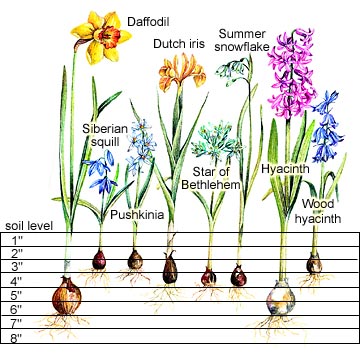
Positioning bulbs at their proper depth helps ensure their longevity. Generally bulbs should be planted so the bottom rests at a depth that's two-and-a-half times the bulb's diameter. In well-drained or sandy soil, plant an inch or two deeper to increase longevity and discourage rodents.

Because bulbs look best planted in groups, you are better off using a garden spade instead of a bulb planter, which encourages you to plant bulbs singly. A spade makes it easier to set bulbs side by side in large groups. Plant groups of bulbs in holes no smaller than a dinner plate, or dig wide, curving trenches and position the bulbs in the bottom.
Layer different types of bulbs from bottom to top in the same hole to create companion plantings or a succession of bloom in a given location. For example, dig a 6-inch-deep hole and place several Dutch hyacinths in the bottom, lightly cover them with soil, then plant a handful of grape hyacinths at a 5-inch depth. The two types of hyacinths bloom at the same time in spring.

The grape hyacinths create a softening skirt beneath the more massive Dutch hyacinths. As another benefit, the leaves of the grape hyacinth bulbs appear in autumn and remain all winter, providing a marker for the dormant Dutch hyacinth bulbs, so you won't inadvertently plant on top of the hyacinths or dig them up.

Interplanting provides maximum flowers in the smallest space and eliminates bare spots where bulbs go dormant. To create a succession of bloom and foliage, plant perennials around the bulb holes. As the bulb foliage dwindles, the perennials will grow up, camouflaging the bulbs' yellowing leaves. This interplanting technique works in both formal and informal gardens.

The Crocus Bank
by Kathy Purdy (www.coldclimatgardening.com)

“There ya’ go, lady. All’s ya gotta do is sprinkle some grass seed and you’re all set.” I smiled and thanked the hard-hatted foreman of the highway crew, and then turned to survey the damage.

Early that autumn morning the foreman had knocked on my door, informing me that they wanted to regrade our dirt driveway so that it tipped slightly to the south and funneled water into the ditch at the side of the road instead of directly into the road. During the freeze/thaw cycle of mud season, the runoff collected in a puddle in the middle of the road and froze, creating a traffic hazard. I had no desire to see an automobile spin out of control in front of my house, so I readily agreed. Unbeknownst to me, however, they decided to do me a “favor” and regrade the southern bank of the driveway, moderating the slope so it would be easier to mow. I could see that the slope was now much shallower, but I could also see that no grass would grow there without a serious investment of work and money. The topsoil had been completely scraped away, and a few roots from the venerable maple tree growing in that corner of the property poked through. Horticulturally, it was a disaster.

The first thing I did was–nothing. We had just funneled all our financial resources into replacing our completely inadequate septic tank, and there was no money for the kind of soil renovation needed to make seeding grass worthwhile. And with a four-month-old baby plus six other children aged eleven and under to get ready for my sister’s wedding, I didn’t exactly have a lot of spare time in which to tackle the project. I was curious to see what would grow there on its own, and I was hoping the fallen leaves from the maple would make a start on the road back to fertility. I also thought that maybe, just maybe, I didn’t want to grow grass there. It wouldn’t hurt to think it over during the winter.

Can you see me writing to the question-and-answer column of a gardening magazine: “Dear Horticultural Expert, please tell me what plants will grow in clay subsoil. Yours truly, Incredibly Naive.” At least I knew enough to know that I didn’t know much. I read garden books and magazines voraciously while breastfeeding and throughout each winter, hoping to find the magic solution. In the meantime, the weeds grew and the leaves fell in their season, and the mown weeds and the fallen leaves were left in place to enrich the soil.

Finally, an article from the May 1990 issue of Fine Gardening about growing small bulbs in a buffalo grass lawn inspired me. Crocus, it seems, originally grew on the arid steppes of Asia. They expect drought in the summer and they don’t need fertile soil to survive. Well, why not, I thought. I’d certainly felt the need for more spring color, and the White Flower Farm catalog had the most seductive photos. Their prices were rather less seductive, however, and I decided to imitate their blue and white crocus collection by purchasing the bulbs from a more reasonably priced merchant. In 1994 I bought 70 Princess Beatrix, 35 Violet Queen, 48 Snowbunting (fragrant), 30 Queen of the Blues, 30 Snowstorm and 45 Striped Beauty for a total of 258 bulbs.

It sounded like a lot of bulbs to me, and I was sure they would cover the bank, so I dutifully planted them 2 to 3 inches apart, as recommended by yet another bulb catalog.

Much to my chagrin, when I was all done only a third of the slope was planted. I had never even attempted calculating the square footage of the area I wanted to cover. Having learned my lesson, I tried to come up with an approximate square footage for the irregularly shaped area, and in 1996 I planted 200 mixed crocus, 50 Bluebird, 100 Prinses Beatrix,100 Miss Vain (fragrant), 100 Violet Queen for a total of 550 more bulbs. This time I also planted 50 bulbs of Tulipa bakeri ‘Lilac Wonder,’ which I thought would also do well and would extend the season. I have to admit, I did kind of fall for the White Flower Farm catalog copy, which described this tulip as looking like “a sweetly pink Crocus that arrived too late to the party.”

But, once again, I didn’t buy it from them. I am so cheap (frugal? thrifty?). It was that same character trait which prompted me to buy the mixed color crocuses. Per bulb, they were much less expensive than the named varieties, and I figured I could dig the yellow ones out and replant them elsewhere, and still come out ahead. In the end, I decided to keep them there. The blues and the whites tend to disappear against the background of dormant vegetation, but the little zings of golden yellow grab your attention and focus it on the whole planting.

Planting these little bulbs was definitely a labor of love. I could only plant after a good soaking rain, otherwise the subsoil was impossible to penetrate. I used a sturdy dibble and bore down on it with my weight while rotating it to drill a hole. Ironically, I was delighted to come across small rocks; they actually made the job easier. I would take one of those forked dandelion weeders and pry the rock out, and use the cavity as my planting hole. Once I dropped a corm in, I stuck my thumb in the hole and made a “C” with my thumb and forefinger. Where my index finger landed, that’s where I planted the next one. Six hundred bulbs, one at a time. It did get tedious. What kept me going was not wanting to waste the money I’d spent (frugality rears its ugly head once again), and the memories of cabin fevers past. And, of course, with the second batch, I had the vision of how nice the first 250 flowers looked to urge me on. I also harbored the secret hope that someday a total stranger would pull over on the side of the road and tell me how much they appreciated them.

If you are familiar with crocus varieties you will know that I planted both the earlier blooming species crocus and the larger but later Dutch crocus. At peak bloom most of both kinds are blooming (this might not be so further south with a longer spring) and the effect is glorious. On a warm day you can catch a tantalizing whiff of the fragrant varieties and the bees are ecstatically buzzing from blossom to blossom. In late afternoon they are backlit by the sun and especially enchanting.

The crocuses have been a good start, but at this point I don’t feel that the problem of the slope has been solved. It has filled in, on its own, with grass and weeds to point that it resembles the rest of what passes for a lawn in these rural parts. I am at a crossroads: I have to decide if I just want my big display of crocus and then maintain it as part of the lawn, or if I want it planted with something more decorative all the time. Right now I have a foot in both camps, and the results look as ambivalent as I feel. The ‘Lilac Wonders’ are pretty, but they bloom so much later than the crocus that the grass has grown up six inches around them, and you can’t see them when they’re blooming. And then you have to wait for the foliage to die down before you mow. If
I’m going to keep them there, I should get rid of all the grass and plant the slope intensively with ornamentals, otherwise it’s going to look unkempt for at least as long as it looks terrific.

On the other hand, I read an article by Brian Bixley (“The Search For a Mowable Ground Cover,” Horticulture May ’99, pp. 64-66) on his approach to taming a difficult-to-mow area. He planted a combination of colchicums with Geranium himalayense and G. endressii. The groundcovering geraniums provided bloom and foliage generous enough to hide the dying colchicum leaves. In late summer he mowed down the geranium foliage so that the display of colchicum blossoms was unobstructed. The geranium foliage grew back as the colchicum flowers died off. I tried sticking some rooted pieces of Geranium sanguineum in a few places on the slope as an experiment. They hung around for one growing season, maybe two, and then disappeared from sight. I am not sure if the lawnmower got them, or drought, or if they just got choked out by the surrounding vegetation. (Bixley killed off all his grass with Roundup before planting his geranium seedlings, but I didn’t have the courage to do that. Also, he has free-draining soil versus my clay subsoil, so I’m not sure what would be the best geranium for my situation.) I had plenty of surplus colchicums on hand, and I interplanted them with autumn flowering Crocus speciosus in one spot.

Much to my surprise, the crocuses bloom after the colchicums, but they both looked mighty cheerful in the fall. I love the idea of the whole slope spangled with the lavender-pink colchicum blooms in the fall, but colchicum leaves take even longer to die down in spring than the tulip leaves, so I’m back to the problem of an unmown bank for all of spring and a good part of summer unless I can figure out how to get the geraniums to grow. I’m back to the modus operandi that I started with in the beginning: until I’m certain what I want to do, I’ll do nothing.

Except, of course, to enjoy the crocuses this spring.

Cold Hardy Perennial Flowers
By Kelly Andersson, eHow.com

Hardy perennials, which, by definition, return year after year, will survive harsh winters---some even without mulch or other protections. The downside, according to Clemson University Extension Service, is that many winter-tough perennials won't thrive in long, hot summers.

Choosing hardy perennials well suited to your conditions will increase chances of long-lived blooming plants in your yard.

Groundcovers: Many groundcover perennials will survive hard winters and spread each year.
Alpine rock cress grows 6 to 12 inches high with early-spring, pinkish-white blooms; it does best in full sun. Excellent for rock gardens, rock cress complements a planting of spring bulbs.

Creeping phlox is low growing and blooms in mats of flowers early in the spring. A rapidly spreading perennial, creeping phlox is available in a range of colors. Tiarella, also known as foam flower, prefers shady spots and puts up spikes of pink blooms in late spring.

Shrubs/Foliage Plants: One of the best known hardy perennials, basket-of-gold is a shrubby yellow perennial sometimes called gold dust. It grows up to 12 inches and blooms from mid-spring through early summer. It needs full sun and dry, well drained soil; according to the North Dakota State Extension Service, many hardy perennials are subject to root rot in poorly drained soil. Another sun-loving perennial, blue dogbane, blooms in early summer, with light blue flowers on 3-foot plants.

For shady areas, the large-leafed ligularia, also known as golden groundsel, blooms with daisy-like flowers in leafy clumps. Another hardy perennial, sea holly blooms with blue and grey-green flowers beginning in mid-summer. Sea holly can grow up to 4 feet, with large, attractive leaves; it prefers full sun. Gayfeather, also known as liatris, attracts butterflies and bees; it has grassy foliage and flowers in late summer with feathery spikes of pink, purple or white blooms.

Shade-Tolerant Hardy Perennials: In shady gardens, astilbe blooms in early summer and will grow from 1 to 4 feet tall. A small and pretty hardy perennial that will grow just about anywhere is yarrow---it grows wild in many areas of the country and will bloom and re-bloom in the harshest conditions. Another classic perennial, the bleeding heart is far more hardy than its delicate blooms would suggest. It does well in shaded areas and survives for years if well established. Penstemon, popular in many northern gardens, is available in many colors and varieties---check for shade tolerance for the varieties you choose.

Tall Bloomers: Veronica, sometimes called speedwell, blooms in early summer and is available in several varieties. Another blue perennial with notable hardiness is May Night salvia; it grows up to 3 feet and blooms all summer. If you love foxgloves but they won't survive in your area, try monkshood---it puts up tall spires late in the summer with deep blue flowers that attract butterflies and bees.

Horti-Culture Corner (Bonus)

It should be said, though without any intention of adding to the world’s already adequate store of guilt, that the average gardener is surprisingly lazy and, not to split hairs about it, pig-headed.
Henry Mitchell

One Bad Gardening Joke….

Two friars are having trouble paying off the belfry, so they open a florist shop.
Everyone wants to buy flowers from the men of God so business is quickly booming.
The florist across town sees a huge drop in sales and asks the two friars to close their shop, but they refuse.
A month later the florist begs the friars to close because he’s having trouble feeding his family.
Again, they refuse, so the florist hires Hugh McTaggert.
Hugh is the roughest, toughest thug in town and is hired to “persuade” the friars to close.
Hugh asks the friars to close their florist shop.
When they refuse, he threatens to beat the crap out of them and wreck their shop every day they remain open, so they close.
This proves once again that Hugh and only Hugh can prevent florist friars. ~

…deserves another

I left packet a of seeds in my pocket and my coat turned into a Chia jacket.

Wednesday, September 14, 2011

September 2011

Planters Punchlines
Men’s Garden Club of Wethersfield
September 2011

~~~~~~~~~~~~~~~

Garden Club Kicks off 2011-12 Season
Monday Sept. 26 @ 7:00 p.m. Pitkin Community Center


No agenda or speaker. Traditionally the Sept. meeting is to get reacquainted, talk over summer happenings, and discuss plans for the upcoming year. Let the arguing begin.

2011-2012 Club Officers
President: Tony Sanders
Vice President: John Swingen Jr.

Secretary: Fred Odell
Treasurer: Richard Prentice


Please welcome prospective club member Ben Nichols. Ben recently moved to Newington from the Syracuse, NY area where he was a member of the Men’s Garden Club of Syracuse.

Compostable Matter
By Jim Meehan

The bees seem to be getting really fat on our Phlox pollen this year. Really, really fat! Hindenbee fat! Supersize me fat! Heavy enough to bend the plant ninety degrees fat! Able to hang on to a fragile petal in twenty miles per hour wind fat!

This summer, for various reasons, I have spent more time looking out our front family room windows than I usually do. The view out into our yard is partially obscured by several pink Phloxes that have lived there with varying degrees of success for the past decade or so.

Marsha uses the growth of these tall perennials as an indoor guide to the passage of the gardening season. In early summer they make their first annual appearance barely peeking over the top of the widow sill. Then week-by-week they climb past the two white horizontal lines formed by the frames inside the windows panes. Finally they shoot up into the upper windows and sway calmly in the light warm weather breeze.

I didn’t really notice the bees until late July. They were, at that time I thought, larger than I remembered from years before. And now they seem to be considerably larger still.

Now granted “considerably larger” in a bee is a relative concept. According to www.bees-online.com the average size of a bumblebee is from 12 to 16 millimeters (1/2” to 5/8”) and their standard weight is one tenth of a gram or four one hundredths of a ounce. For comparison one M&M candy (regardless of color) is ten times heavier at 1.13 grams/ .04 ounce.

Periodically one or two of the little honey-makers sneaks inside our family room and hangs out at these self same windows looking longingly at these self same Phlox. This breach in our security has been going on for several years and Marsha and I have yet to figure out where the point of entry is. In any event the bees are quite passive – either hovering lazily alongside the glass or taking a break on the windowsill. My job is to capture our visitors in some paper product, usually a napkin, and (without crushing them) to transport them back to their native outdoor habitat. The wood pulp cocoon feels weightless and if it were not for the gentle vibrations I can feel in my hands I would have no idea whether I was carrying anything or not.

Once outside I open up the swaddle like a magician releasing a dove and the bee floats away into the ether. The audience in my family room politely applauds.

Still, in spite of their gravity-free state, the little humming insects seem to me to be transitioning from being quite easily seen, to extremely noticeable, to blocking-out-the-son enormous. So I decided to carefully observe what was happening in my family room garden. Here, combined with some supporting information that I gleaned from the Internet, are my findings.

All morning the Phlox is in the shade. There is absolutely zero bee activity.

At noon the sun begins to warm the tall pink perennials and shortly thereafter the bees, mid-sized and agile, arrive by the dozen. For about an hour they dart from flower to flower, somehow avoiding mid-air collisions. Then the majority (presumably younger guys with other things to do) leave. Two of them, whom I’ve named Cliff Clavin and Norm, settle in for the afternoon.

By two p.m. Cliff and Norm have attached themselves firmly to their favorite barstools and are growing both larger and logier as their bodies and brains become progressively more encased in nectar. This increase in size and lethargy continues throughout the afternoon until, fully satiated, they drag themselves slowly away from their afternoon hangout and head home where they are hailed as heroes and gently stripped of their temporary sweet outer skins by their fellow hive mates. Then, after sleeping it off, they come back the next day for another round, or two, or three.

Not every worker bee is cut out for it – witness all of the less experienced early afternoon dropouts. But if it is what you are meant to be, it’s probably not that bad a life being a “regular”.

Sometimes you want to go
Where everybody knows your name,
And they're always glad you came;
You want to be where you can see,
Our troubles are all the same;
You want to be where everybody knows your name.

Vertical Farming:Does it Really Stack Up? The Economist

Agriculture: Growing crops in vertical farms in the heart of cities is said to be a greener way to produce food. But the idea is still unproven

WHEN you run out of land in a crowded city, the solution is obvious: build upwards. This simple trick makes it possible to pack huge numbers of homes and offices into a limited space such as Hong Kong, Manhattan or the City of London. Mankind now faces a similar problem on a global scale. The world’s population is expected to increase to 9.1 billion by 2050, according to the UN.

Feeding all those people will mean increasing food production by 70%, according to the UN’s Food and Agriculture Organisation, through a combination of higher crop yields and an expansion of the area under cultivation. But the additional land available for cultivation is unevenly distributed, and much of it is suitable for growing only a few crops. So why not create more agricultural land by building upwards?

Such is the thinking behind vertical farming. The idea is that skyscrapers filled with floor upon floor of orchards and fields, producing crops all year round, will sprout in cities across the world. As well as creating more farmable land out of thin air, this would slash the transport costs and carbon-dioxide emissions associated with moving food over long distances. It would also reduce the spoilage that inevitably occurs along the way, says Dickson Despommier, a professor of public and environmental health at Columbia University in New York who is widely regarded as the progenitor of vertical farming, and whose recently published book, “The Vertical Farm”, is a manifesto for the idea. According to the UN’s Population Division, by 2050 around 70% of the world’s population will be living in urban areas. So it just makes sense, he says, to move farms closer to where everyone will be living.

Better still, says Dr Despommier, the use of pesticides, herbicides and fungicides can be kept to a bare minimum by growing plants indoors in a controlled environment. Soil erosion will not be a problem because the food will be grown hydroponically—in other words, in a solution of minerals dissolved in water. Clever recycling techniques will ensure that only a fraction of the amount of water and nutrients will be needed compared with conventional farming, and there will no problem with agricultural run-off.

A wide variety of designs for vertical farms have been created by architectural firms. (The idea can arguably be traced back as far as the Hanging Gardens of Babylon, built around 600BC.) So far, however, the idea remains firmly on the drawing board. Would it really work?

“Without artificial lighting the result will be an uneven crop, as plants closest to the windows are exposed to more sunlight and grow more quickly.”

The necessary technology already exists. The glasshouse industry has more than a century’s experience of growing crops indoors in large quantities, says Gene Giacomelli, director of the Controlled Environment Agriculture Centre at the University of Arizona in Tucson. It is now possible to tailor the temperature, humidity, lighting, airflow and nutrient conditions to get the best productivity out of plants year round, anywhere in the world, he says. The technology of hydroponics allows almost any kind of plant to be grown in nutrient-rich water, from root crops like radishes and potatoes to fruit such as melons and even cereals like maize.

There are a number of ways to do it, but essentially hydroponics involves suspending plants in a medium—such as gravel, wool or a form of volcanic glass known as perlite—while the roots are immersed in a solution of nutrient-rich water. A constant flow of air keeps the plants bathed in carbon dioxide. Any nutrients and water that are not taken up by the roots can be recycled, rather than being lost into the soil. “You can grow anything with hydroponics,” says Dr Giacomelli.

He and his colleagues have created the South Pole Food Growth Chamber, which has been in operation since 2004. This semi-automated hydroponic facility in Antarctica is used to provide each of the 65 staff of the Amundsen-Scott South Pole Station with at least one fresh salad a day during the winter months, when supply flights to the station are extremely limited. The chamber has a floor area of 22 square metres and produces a wide range of fruit and vegetables with little more than the occasional topping up of water and nutrients. It does, however, require artificial lighting because the station is without natural daylight for most of the winter.

And that highlights a big potential stumbling-block for vertical farming. In the Antarctic the need to provide artificial light is a small price to pay for fresh food, given the cost of importing it.

But elsewhere the cost of powering artificial lights will make indoor farming prohibitively expensive. Even though crops growing in a glass skyscraper will get some natural sunlight during the day, it won’t be enough. Without artificial lighting the result will be an uneven crop, as the plants closest to the windows are exposed to more sunlight and grow more quickly, says Peter Head, global leader of planning and sustainable development at Arup, a British engineering firm. “Light has to be very tightly controlled to get uniform production of very high-quality food,” he says.

Indeed, even in today’s single-storey glasshouses, artificial lighting is needed to enable year-round production. Thanet Earth, a 90-hectare facility which opened in Kent in 2008 and is the largest such site in Britain—it provides 15% of the British salad crop—requires its own mini power-station to provide its plants with light for 15 hours a day during the winter months. This rather undermines the notion that vertical farming will save energy and cut carbon emissions, notes Mr Head, who has carried out several studies of the idea. Vertical farming will need cheap, renewable energy if it is to work, he says.

Some researchers, such as Ted Caplow, an environmental engineer and founder of New York Sun Works, a non-profit group, argue that even using renewable energy the numbers do not add up. Between 2006 and 2009 Dr Caplow and his colleagues operated the Science Barge, a floating hydroponic greenhouse moored in Manhattan (it has since moved to Yonkers). “It was to investigate what we could do to grow food in the heart of the city with minimal resource-consumption and maximum resource-efficiency,” says Dr Caplow.

The barge used one-tenth as much water as a comparable field farm. There was no agricultural run-off, and chemical pesticides were replaced with natural predators such as ladybirds. Operating all year round, the barge could grow 20 times more than could have been produced by a field of the same size, says Dr Caplow.

Solar panels and wind turbines on the barge meant that it could produce food with near-zero net carbon emissions. But the greenhouses on the barge were only one storey high, so there was not much need for artificial lighting. As soon as you start trying to stack greenhouses on top of each other you run into problems, says Dr Caplow. Based on his experience with the Science Barge, he has devised a rule of thumb: generating enough electricity using solar panels requires an area about 20 times larger than the area being illuminated. For a skyscraper-sized hydroponic farm, that is clearly impractical. Vertical farming will work only if it makes use of natural light, Dr Caplow concludes.

One idea, developed by Valcent, a vertical-farming firm based in Texas, Vancouver and Cornwall, is to use vertically stacked hydroponic trays that move on rails, to ensure that all plants get an even amount of sunlight. The company already has a 100-square-metre working prototype at Paignton Zoo in Devon, producing rapid-cycle leaf vegetable crops, such as lettuce, for the zoo’s animals. The VerticCrop system (pictured) ensures an even distribution of light and air flow, says Dan Caiger-Smith of Valcent. Using energy equivalent to running a desktop computer for ten hours a day it can produce 500,000 lettuces a year, he says. Growing the same crop in fields would require seven times more energy and up to 20 times more land and water.

But VertiCrop uses multiple layers of stacked trays that operate within a single-storey greenhouse, where natural light enters from above, as well as from the sides. So although this boosts productivity, it doesn’t help with multi-storey vertical farms. Even if each floor rotates its crops past the windows so that all plants receive an equal amount of natural light, overall they would get less light, and so produce less biomass, says Dr Caplow. He prefers the idea of the “vertically integrated greenhouse”. This idea involves the integration of vertical farms into buildings and offices, with plants growing around the edges of the building, sandwiched between two glass layers and rotating on a conveyor. Shrouding buildings with plants solves the natural-light problem for agriculture, acts as a passive form of climate control for the buildings and makes for a nice view. But the area available is much smaller.

The immediate opportunity may simply be to take advantage of the space available on urban rooftops, says Mr Head, and to pursue urban farming rather than vertical farming. BrightFarms Systems, a commercial offshoot of NYSW, is working with Gotham Greens, another company to emerge from the Science Barge, to create the world’s first commercial urban hydroponic farm in Brooklyn. When it opens in 2011, the 15,000 square-foot rooftop facility will produce 30 tonnes of vegetables a year which will be sold in local stores under the Gotham Greens brand name.

Although this is urban hydroponics, not vertical farming, it is a step in the right direction, says Mr Head. “I wouldn’t be at all surprised if we saw large retailers with greenhouses on their roofs growing produce for sale in the shop,” he says. A few examples of this have already sprung up. BrightFarms, for example, together with a firm called Better Food Solutions, began constructing a large single-storey glasshouse on the roof of a big supermarket in October. The supermarket agrees to buy the produce and owns the farm, while Better Food Solutions builds it and runs it.

The first fruit and vegetables are expected to go on sale in early 2011.

It is unclear how competitive this will be. Rooftop farming may not be able to compete with other suppliers in a global market unless people are prepared to pay a premium for fresh, local food, says Mr Head. And it is much less glamorous than the grand vision of crops being produced in soaring green towers of glass. But, for the time being, this more down-to-earth approach is much more realistic than the sci-fi dream of fields in the sky.

Grow food in winter without heated greenhouses
by Ian Aldrich (www.chelseagreen.com)

For more than 30 years, Eliot Coleman of Harborside, Maine, has successfully grown food in winter without heated greenhouses. Think outside your zone. Each winter, his gardens head south, to Georgia, without moving an inch.

How? For every layer of protection--a cold frame, for example--the growing environment shifts 500 miles. By doubling up, says Coleman, winter farmers never have to contend with frozen soil, not even when the mercury drops well below zero. "You might get a little surface freezing, but by 10 a.m. it will be unfrozen," he says. "The minute the sun comes out, all of a sudden it's 50 degrees in there. We've never had a day when we couldn't put seeds in the greenhouse beds."

For more on winter gardening, go to: Four Season Farm @ http//fourseasonfarm.com

Hoop Houses: Coleman says you can find simple, inexpensive options out there to protect your plants. If you're already using a cold frame, he recommends getting six unused 2x4s and building an A-frame around the structure, then wrapping the new enclosure in greenhouse plastic.

No cold frame? No problem. Coleman is also a big fan of "hoop houses," small enclosures made from semicircle- shaped strips of metal or plastic piping covered in plastic. "I've been doing this a long time, and I'm still like a little kid when I go in there and see what's happening," he says. "It's amazing that it just works."

Begin in August: Coleman's winter planting begins in early August and extends through mid-September, a period he likes to refer to as a "second spring." "You have to get the plants established while the growing season still has something left to it," he says.

Spinach for Winter: For all would-be winter gardeners, Coleman suggests going with spinach, which can be harvested four times, growing well into February. "It keeps renewing itself," he says.

No Weeds, No Watering: Unlike summer warmth, colder temperatures mean that pests and even weeds are nearly eliminated. Even better: Between November and February, says Coleman, gardeners don't have to water their plants. "The water table is higher," he says, "and because the sun is so low, there isn't much evaporation."

Baby Lettuce is Better: It's true, says Coleman: Small really is better when it comes to winter gardening. Baby leaf greens are not only hardier, they're tastier. "A full-size lettuce will freeze two or three times and turn to mush," he says. "A three-inch-tall baby lettuce leaf will freeze and thaw all winter long and recover each day."

Salad Every Night:Newbie winter gardeners can do just fine--and eat really well, too--with a simple 5-by-10-foot planting space. "With baby greens, if you plant them right--and you can put rows as close as two inches apart--you can have a salad every night all winter long."

Fall flowers and grasses for show-stopping color
www.flower-gardening-made-easy.com

Fall flowers - a lot of gardeners seem to miss out on them. As August comes to the perennial garden, they're ready to throw in the towel. It's a shame: for northern gardeners the growing season is short enough, so why not extend the flower show well into fall with some lovely late-bloomers and ornamental grasses?

Perennials and grasses star in the late season: I'm enchanted with the autumnal look pioneered by garden designers Wolfgang Oehme and James van Sweden in the United States, and Piet Oudolf, in Holland.I've designed my own garden to be at its peak in late summer because I adore fall flowers and the ornamental grasses that look so good with them. For the most part, plants that bloom in late summer and fall are tough, drought tolerant and many of them grow tall and dramatic. Another interesting thing about many of these fall flowers is how many of them are North American natives, which probably accounts for their toughness: they shrug off the drought, heat and humidity of our summers because that's the very climate that shaped their evolution.

Best fall flowers for the perennial garden:

ASTER: With their clouds of daisy-like flowers in pink, rosy-lilac or deep purple, asters are classic fall flowers. Robust and hardy, many garden hybrids stem from the native New England and New York asters. Old favorite taller varieties growing 3 to 4 feet tall include the glowing salmon-pink 'Alma Potschke' and the lavender-blue Aster frikartii 'Mönch'. The more recently introduced 'Purple Dome' grows a compact 18 inches tall. Asters thrive in full sun in moist, rich soil, but can look a little weedy during the growing season, so tuck them in among other earlier-flowering perennials. In late June, pinch or prune stems back by half to prevent floppiness and stake taller varieties. Keep asters vigorous by dividing in spring every two or three years. Some of the older varieties were plagued by mildew, but newer ones are resistant: look for Aster laevis 'Bluebird', with single violet blue flowers, Aster lateriflorus 'Prince', which has unusual dusky plum-purple foliage and tiny white star-like flowers with a raspberry colored eye, and Aster oblongifolius 'October Skies', which has blue flowers in September to October.

JOE PYE WEED (Eupatorium maculatum or E. purpureum ): Another plant I wouldn't be without has the unfortunate common name, Joe Pye weed.
But this North American native is not the least weedy. Its botanical name Eupatorium is much more gracious, just like the plant. Tall (in the 4 to 5 foot range) and stately, it's a real butterfly magnet for almost six weeks in late summer when its large heads of tiny, dusky pink flowers bloom. A widely available cultivar is 'Gateway'. For gardeners looking for more compact versions, a recent cultivar, 'Phantom', is supposed to grow only 3 feet tall. This perennials makes a terrific accent plant and mixes well with other late season stars, such as Echinacea, Rudbeckia 'Goldstrum', Sedum 'Autumn Joy' or 'Matrona' and ornamental grasses.

HELENIUM: For show-stopping daisy-like flowers in hot colors, try hybrids of the North American native, Helen's Flower (Helenium autumnale). 'Bruno', a Bressingham selection from England has crimson-mahogany flowers; 'Red and Gold' produces brick red and gold yellow flowers; 'Butterpat' has deep yellow flowers and 'Moerheim Beauty' bright, reddish-orange blooms. About 3 to 4 feet tall, heleniums complement autumn's palette of golds, crimsons and oranges. These late summer to fall flowers thrive in full sun in moist humus-rich soil. Regular moisture is important, so don't let them dry out in summer.

CROWN OF RAYS GOLDENROD (Solidago 'Crown of Rays'): The is one of the new generation of goldenrods that I hope will help gardeners overcome the prejudice against these plants as mere roadside weeds. Goldenrod is unfairly blamed for causing hay fever. Ragweed, which blooms at the same time, is the real culprit. 'Crown of Rays' is clump-forming goldenrod hybrid with many tiny, bright yellow flowers on dense, horizontal, plume-like panicles. This late summer to fall flowering perennial thrives in full sun and well-drained soil and grows about 24 inches tall. Plants may need to be divided every 2 to 3 years to control growth.

RUSSIAN SAGE (Perovskia atriplicifolia): Russian sage is a fall flower with a very long bloom time. The plant grows upright and has attractive lacy-looking greyish leaves that smell like sage. Violet-blue flower spikes appear in mid-summer and continue well into fall. This drought-tolerant perennial grows well in sunny, hot, dry sites. It is a good butterfly plant, and deer-resistant. Grows about 3 feet tall and 24 to 30 inches wide. Don't cut back in fall; wait until spring and then cut to 6 inches from the ground. More growing information on Russian sage.

PINK CULVER'S-ROOT (Veronicastrum virginicum 'Fascination': This is a lovely selection of a North American native wildflower. Growing tall - about 4 to 5 feet, but with strong stems that usually don't require staking - the plant bears large branching spikes of lilac-mauve flowers in mid to late summer and continue into early fall. The flowers arch gracefully at the tips - they look a bit like mermaid's tails - and make good cut flowers. Also attractive to butterflies, and deer-resistant. Adaptable to most soils; grow in full sun.

JAPANESE ANEMONE (Anemone x hybrida, A. hupehensis var. japonica)
For shadier spots in the garden, consider delicate-looking fall-flowering Japanese anemones. Growing 2-1/2 to 3 feet tall, these fall flowers grow on slender, branching stalks, and spread to form a large patch. Lobed leaves form attractive mounds of foliage, and the flowers look poppy-like. Favorite cultivars are silvery-pink 'September Charm', light pink 'Queen Charlotte' and glowing white 'Honorine Jobert'.
Plant Japanese anemones in rich, moist, well-drained soil, where they'll have afternoon shade. Anemones benefit from a winter mulch and regular deep watering in dry weather.
Add more fall interest with ornamental grasses: If you have a sunny garden, ornamental grasses are another great way to extend the season of interest into the late fall. Look for well-behaved clump-forming perennial types. The following are some of my favorites, and they all mix well with fall flowers:
* Dramatic and upright-growing Karl Forester feather reed grass (Calamagrostis x acutiflora 'Karl Forester').
* The white and green variegated Morning Light miscanthus (Miscanthus sinensis 'Morning Light').
* Tall airy cultivars of purple moor grass (Molina caerulea) seem always to be in motion. Look for cultivars 'Transparent', 'Skyracer', or 'Windspiel', German for "wind play" - a terrific description of the wonderful dance of grasses on the breeze.
* Dallas Blues switch grass (Panicum virgatum 'Dallas Blues') and North Wind upright switch grass (Panicum virgatum 'Northwind') are two more excellent choices.

Horti-Culture Corner September (Excerpt) by Helen Hunt Jackson

The golden-rod is yellow;
The corn is turning brown;
The trees in apple orchards
With fruit are bending down.